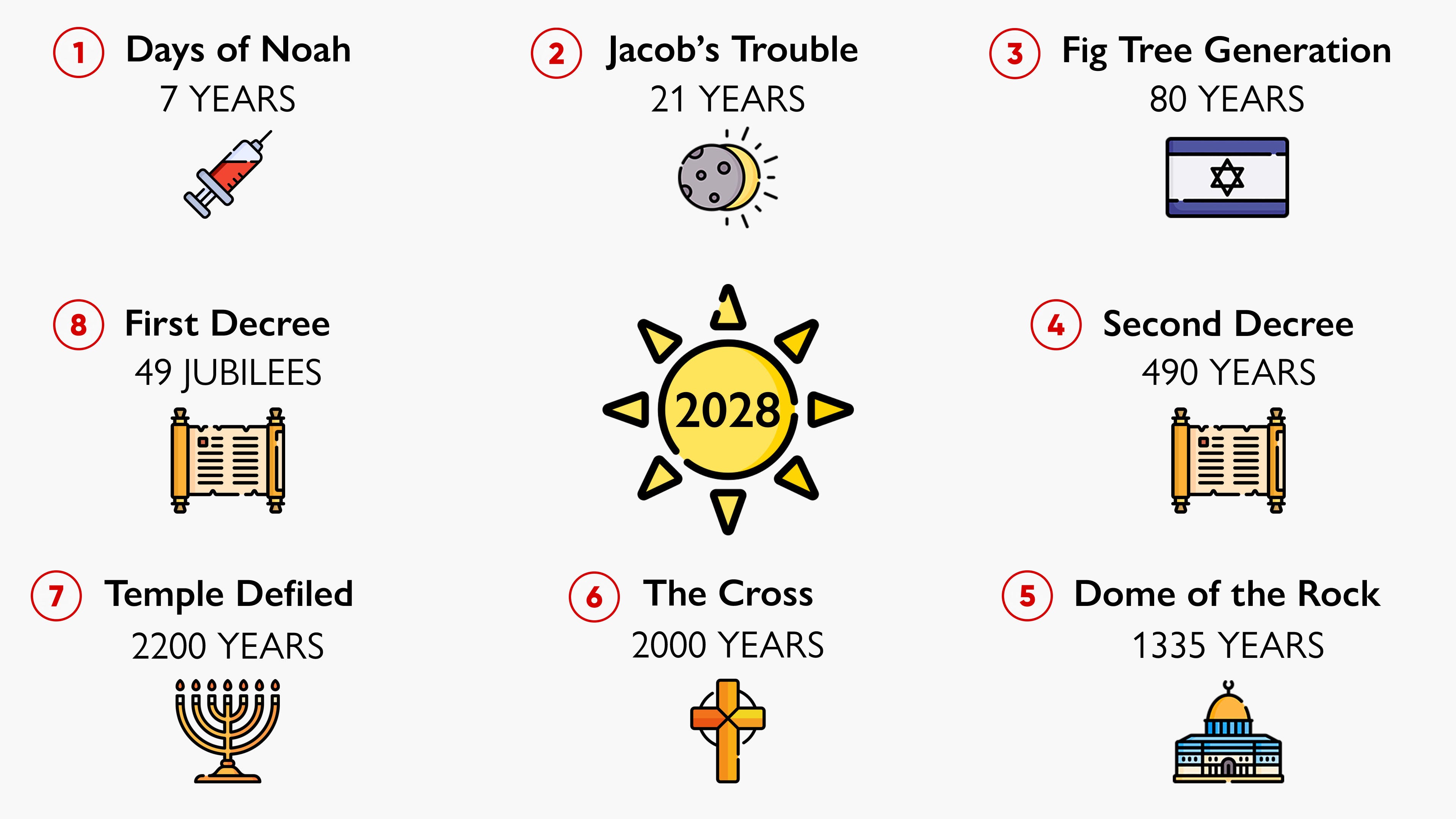
Note: seven of these prophecies and their fulfillments are described in more detail in my book God’s Final Week. The eighth (number 4 in the list below) is covered in Nugget #1. The point of this post is to bring them all together into one place for quick accessibility.
There are eight numeric prophecies contained in the sacred Scriptures which, when rightly understood, serve as markers pointing to the year of Christ’s return.
8 - The First Decree and the 49 Jubilees
One of the interesting aspects of the 70 weeks prophecy, which often does not get the attention it deserves, is how the first 69 weeks are divided into 7 and 62 in verse 25. The year-for-a-day principle (Numbers 14:34), in which a prophetic day is considered to be symbolic of a year, allows us to make sense of these weeks. Indeed, it has been widely known for much of Church history, and has been calculated many times over, that the 483 years – which equals 69 weeks of 7 years each – takes us from approximately 457 BC up to AD 27. This leads us up to the exact starting point of Yeshua’s ministry. (Remember, whenever you cross over from BC to AD, you must subtract a year, since there is no zero year.)
A great deal of scholarly work has gone into the identification of the 457 BC date for Artaxerxes’ decree to restore and rebuild Jerusalem. For our purposes, the important point is that it can likely be trusted to be accurate within one year (quite a feat given that it took place nearly 2,500 years ago).
Is this why some astute Jews, including many of Yeshua’s disciples, were looking for the Messiah to appear right around the time when his earthly ministry began? Had they done the math based on the 70 weeks prophecy? It appears many had.
And as the people were in expectation, and all men mused in their hearts of John, whether he were the Christ, or not …
— Luke 3:15
Still, we have the question of why the 69 weeks were not listed plainly as such. Why 7 and 62? Clearly, the math from Artaxerxes’ decree to the beginning of Yeshua’s ministry is much too close to 483 years to be purely coincidental. Yet, as we know, prophecies in Scripture can sometimes point to more than one future fulfillment. Is there perhaps a double meaning to this prophecy?
Sir Isaac Newton, one of the greatest minds to be found in all of the sixth millennial day, certainly thought so. He believed that the 7 and the 62 somehow spoke both to the Messiah’s first appearance, and also to his second appearance at the end of the age. I am inclined to believe he was right.
I believe I have found, by God’s grace, the key which unlocks the meaning of this core prophecy. In the end, the solution is not nearly as complex as you might imagine. Simplicity is, after all, the ultimate sophistication. And yet, we must with humility realize that it is far easier for us to glimpse the beautifully simple truth from our vantage point here at the end of the age. These things were sealed up for many years, only for the scrolls to finally be unwound here in their proper time.
The seven weeks is indeed intended to be counted as years – 49 in all – and added to the 62 weeks of years to arrive at the Messiah’s first coming, as we have seen. These 483 years are precise and lead directly without a gap to the seventieth week. (Note that I believe there are two separate fulfillments of the 490 years.)
However, the seven weeks has a double meaning and is also intended to be counted as 49 Jubilee years. This is the number of Jubilee years between the decree to rebuild Jerusalem and the Second Coming of Jesus Christ. I believe that the Messiah’s return will coincide with or slightly precede (by mere days) the announcement of the 50th Jubilee year, and so this last Jubilee is not counted with the others. Notice how these 49 Jubilee years are a mathematically beautiful reflection of the 490 years contained within the 70 weeks themselves.
Upon consideration, this is also simply a cleverly devised magnification of the Jubilee cycle itself. There are 49 “regular” Jubilees in the prophecy, followed by a fiftieth Super Jubilee, which I believe is only announced shortly after the Second Coming. This fiftieth Jubilee is the final Jubilee, the 120th Jubilee, the ultimate entry into the land of true freedom and the eternal state.
With this realization, we understand that there was only one 50-year period in all of history which the prophecy of Daniel could have pointed to so as to provide such a mathematically beautiful riddle. It had to point to a decree given after the 70th Jubilee from creation, but before the 71st.
The nearest Jubilee marker we have comes from Ezekiel Chapter 1.
Now it came to pass in the thirtieth year, in the fourth month, in the fifth day of the month, as I was among the captives by the river of Chebar, that the heavens were opened, and I saw visions of God. In the fifth day of the month, which was the fifth year of king Jehoiachin’s captivity …
— Ezekiel 1:1-2
Historically speaking, we know that this fifth year of Jehoiachin’s captivity occurred in approximately 594 BC. Verse 1 tells us this year was the thirtieth year of the Jubilee cycle. Let us assume that the Jubilee cycle was faithfully observed – or at a minimum kept track of – as 50 years in length prior to Israel’s captivity; a safe assumption, in my view. This would place the next Jubilee at 574 BC. (I believe the true date to actually be 573 BC, but either year is close enough for our purposes at the moment.)
This Jubilee at 573 BC would have been the 68th from creation. The seventieth Jubilee would have fallen on 473 BC, and sixteen years later, in 457 BC, the decree to rebuild Jerusalem went out, starting the clock for the 490 years.
Incidentally, using this math gives us the 80th Jubilee staring on Tishri 10 of AD 28. And then the 120th Jubilee should follow on Tishri 10 of 2028.
7 - The 2,200 Years
In Daniel Chapter 8, there is the famously misunderstood 2,300 days prophecy. This prophecy is often assumed by most of Christendom to point directly to Antiochus Epiphanes, a Greek king of the second century BC. Because of this, further meaning is often not looked for from the prophecy. However, I believe that several verses in the chapter contain clues pointing to the end times.
So he came near where I stood: and when he came, I was afraid, and fell upon my face: but he said unto me, Understand, O son of man: for at the time of the end shall be the vision … And he said, Behold, I will make thee know what shall be in the last end of the indignation: for at the time appointed the end shall be.
— Daniel 8:17 & 19
Does this sound like something that was fulfilled over two thousand years ago? Does it sound like something that was fulfilled in 1844? These sorts of interpretations do not agree with the plain language of the text.
Now, I do agree that the first 12 verses of the text do point to Antiochus Epiphanes. This much, in my view, is correct. However, the key distinction for this prophecy lies in a correct understanding of verse 14.
And he said unto me, Unto two thousand and three hundred days; then shall the sanctuary be cleansed.
— Daniel 8:14
Interestingly, the Septuagint has the number 2,400 in this verse. Adding to the perplexity of this is the fact that many of the old Masoretic texts contain evidence of this number being edited or tampered with. This can be hard to reconcile until one considers the witnesses of ancient historians. Fortunately for us, both Jerome and Josephus have recorded that some copies of Daniel available in their day yet long since lost to us contained the number 2,200.
It seems most likely that one of the texts upon which the Septuagint was based had over the years developed a scribal error in this particular spot. The Hebrew words for two hundred were simply repeated twice, leading to a value of 2,400. This number then made its way into the Septuagint’s Greek translation. The scribes of the Masoretic scrolls, confronted with texts pointing both to 2,200 and 2,400, might have logically chosen to split the difference and go with 2,300. Hence, the evidence of editing in these scrolls.
Given the historical details we have, it seems that 2,200 was most likely the original number given to Daniel.
Our present histories tell us that in 170 BC, Antiochus – a prefiguring of the Antichrist – entered the Holy of Holies and plundered it, taking away its gold and silver vessels and the seven-branched golden menorah. This may be the starting point from which the “How long?” in Daniel 8:13 is meant to be reckoned, given the context.
Then I heard one saint speaking, and another saint said unto that certain saint which spake, How long shall be the vision concerning the daily sacrifice, and the transgression of desolation, to give both the sanctuary and the host to be trodden under foot?
— Daniel 8:13
Are we to accept it as mere coincidence that 170 BC is 2,197 years from the year AD 2028? Three years of uncertainty in the second century BC is actually quite accurate. Accordingly, I believe the correct starting year is most likely either 173 BC or the later part of 174 BC. And the last end of the indignation will come precisely 2,200 years later, in the year AD 2028.
Incidentally, I find it remarkable that the edited number of 2,300 also has a way of pointing to the Temple and its desolation. Specifically, it points to a New Testament verse linking the concept of a Temple with a physical body.
Jesus answered and said unto them, Destroy this temple, and in three days I will raise it up. Then said the Jews, Forty and six years was this temple in building, and wilt thou rear it up in three days? But he spake of the temple of his body.
— John 2:19-21
When you multiply 46 by the Jubilee cycle of 50, you arrive at 2,300. Or, put another way, there are precisely 46 Jubilee years within a period of 2,300 regular years.
6 - The Third (Seventh) Day
The Millennial Day perspective is undergirded by dozens of repeated typological patterns found in Scripture. However, there is also this revealing prophecy from Hosea.
Come, let us return to the Lord; for he has torn us, that he may heal us; he has struck us down, and he will bind us up. After two days he will revive us; on the third day he will raise us up, that we may live before him.
— Hosea 6:1-2
Since the cross occurred in year 4,000 (the start of Millenial Day 5), we know that the year 6,000 is the start of the third millennial day from the cross. It is also the start of the seventh day from creation. This means that Christ’s resurrection on the third day was in fact symbolic of our future resurrection, which also comes on a third day.
Given the prophecy in Ezekiel 4 and a siege of Jerusalem beginning 3 days before Passover in AD 70 (an accepted historical fact), we can triangulate the year of the cross to AD 29. (There is also some testimony from a few early Church fathers which supports AD 29 as one of the earliest accepted years for the cross.) If Passover AD 29 fell within year 4000, then this means year 4000 must have begun in the fall (Tishri 1) of AD 28.
This means that year 6000 will begin in the fall of AD 2028.
5 - The 1,335 Years
The final chapter of the book of Daniel contains one last cryptic prophecy.
And at that time shall Michael stand up, the great prince which standeth for the children of thy people: and there shall be a time of trouble, such as never was since there was a nation even to that same time: and at that time thy people shall be delivered, every one that shall be found written in the book. And many of them that sleep in the dust of the earth shall awake, some to everlasting life, and some to shame and everlasting contempt. And they that be wise shall shine as the brightness of the firmament; and they that turn many to righteousness as the stars for ever and ever. But thou, O Daniel, shut up the words, and seal the book, even to the time of the end: many shall run to and fro, and knowledge shall be increased.
— Daniel 12:1-4
The reference to the resurrection here is unmistakable. This prophecy is speaking of the very end.
And he said, Go thy way, Daniel: for the words are closed up and sealed till the time of the end. Many shall be purified, and made white, and tried; but the wicked shall do wickedly: and none of the wicked shall understand; but the wise shall understand. And from the time that the daily sacrifice shall be taken away, and the abomination that maketh desolate set up, there shall be a thousand two hundred and ninety days. Blessed is he that waiteth, and cometh to the thousand three hundred and five and thirty days. But go thy way till the end be: for thou shalt rest, and stand in thy lot at the end of the days.
— Daniel 12:9-13
I have seen very few good explanations for the meaning of the 1,290 and the 1,335 days spoken of here, at the very last gasp of this prophetic book. However, I have found one particular interpretation which points to the same endpoint as the 49 Jubilees of the seventy weeks prophecy and the 2,200 years of Daniel 8. Now, I must acknowledge that I did not arrive at this interpretation of Daniel 12 on my own. Instead, finding one that fits well with the other prophecies, I have adopted it into my overall paradigm.
Before I share the interpretation, you must understand that Daniel Chapter 12 stands alone to a certain extent and is not directly linked to the other prophetic passages which precede it. I believe it is also crucial to realize that Daniel 12 is clearly focused on the end of days, the climactic ending of all human history. We can therefore safely rule out any interpretation of the 1,290 and 1,335 which points to an end date hundreds or even thousands of years in the past.
In the apocryphal book of 2 Maccabees, there is a passage describing the prophet Jeremiah’s taking away of the daily sacrifice in Jerusalem just prior to Nebuchadnezzar’s victory over the city.
It was also in the writing that the prophet, having received an oracle, ordered that the tent and the ark should follow with him and that he went out to the mountain where Moses had gone up and had seen the inheritance of God. And Jeremiah came and found a cave, and he brought there the tent and the ark and the altar of incense, and he sealed up the entrance. Some of those who followed him came up to mark the way, but could not find it. When Jeremiah learned of it, he rebuked them and declared: ‘The place shall be unknown until God gathers his people together again and shows his mercy.’
— 2 Maccabees 2:4-7 (ESV)
Now, I am by no means claiming that 2 Maccabees or the other books of the Apocrypha are inspired. However, many of these hidden books are valuable historical sources, though they admittedly do not belong in the Bible. First and Second Maccabees are among the most highly regarded for their historical account of the Intertestamental Period, also known as the Second Temple Period. Perhaps it is for this reason that they were a part of the Apocrypha section of the original 1611 King James Version and were printed between the Old and New Testaments until the mid 1800s. (Most present-day Protestant believers are unaware of this fact.)
The pertinent point is that, while they are uninspired, many of the Apocryphal books contain valuable history for our use.
Jeremiah’s taking of the altar of incense from Jerusalem has been dated to approximately 598 BC. This was the daily sacrifice being taken away.
In AD 692, which just so happens to be 1,289 years later, the Dome of the Rock – an Islamic shrine – was dedicated and built on the Temple Mount, the very ground where the Temple once stood. This, in my view, is an apt outward example of the abomination of desolation and the defilement of the Temple. (It is even more striking for those who grasp the occult symbolism of the dome and its links to the goddess Isis.) And the Daniel 12 prophecy appears to point directly to this particular example.
When you add 1,335 years to 692, you get 2027 to 2028, depending on the time of year when the reckoning began. This is the time period when those who wait will at last be blessed.
4 - The Second Decree and the 490 Years
The ancient Jews expected three fulfillments for key prophecies. So, we should not be surprised to find in history a third fulfillment of Daniel 9 which perfectly aligns with all the rest and with 2028.
Now, from the outset, I want to be clear. All credit for discovering this critical second decree goes to Dr. Christian Widener. I did not discover the decree. I only discovered Widener.
This was truly a monumental discovery, and one which rightfully belongs to Dr. Widener’s name.
This second decree to restore and rebuild Jerusalem was issued by Sultan Suleiman I of the Ottoman Empire. You will find no reference to this decree in our history books (by design, no doubt), though Suleiman himself is well documented. However, God saw fit to preserve the record of this crucial decree literally in stone for us in Jerusalem. And it was Dr. Widener who in these last days discovered the stones which bear witness to this old decree.
In his book, Widener explains that plaza and moat look like the best words to translate rechob and charuwts in Daniel 9:25. He then provides the evidence for Suleiman’s decree, linking it firmly both to a moat and to the Temple Plaza.
There is an actual moat within the Old City of Jerusalem, and it has a plaque proclaiming its restoration by Suleiman; however, there is no date on this specific plaque. Perhaps it was left off, or as the “ … ” suggests at the end of the inscription, the final portion was damaged and became illegible. Fortunately, that is not the only plaque I want to show you. Suleiman also extensively repaired the plaza of the temple, and he placed a fountain (sabil) and another plaque with an inscription to document its restoration. It not only confirms that the Temple Mount was an area restored by Suleiman, but it also gives us a date for his decree. It is called Sabil Bab el Atm, meaning fountain at the Gate of Darkness (see photo, top of next page[174]).
The translation of the plaque (photo above)[175] is: “He has ordered the construction of this blessed Sabil, our Master, the Sultan, the greatest Sultan and the honourable Hakan, who rules the necks of the nations, the Sultan of the lands of Rum, the Arabs and Persians (ajams), the Sultan Suleyman, son of Sultan Selim Khan, may Allah perpetuate his reign and sultanate, On the date of Hijra of the Prophet at the beginning of Shaban the blessed in the year 943. And blessings be upon Muhammad and upon his followers.”[176]
— Dr. Christian Widener (Witnessing the End: Daniel’s Seventy Sevens and the Final Decree Everyone Missed)
In footnote 176, Widener states the source of the plaque translation and then continues.
Tutuncu. Turkish Jerusalem, 74; In total, Suleiman had nearly three dozen inscriptions documenting his work in Jerusalem between 1536-1541. Within the walls of the city, the oldest is at the Sabil el Wad, which is near the Bab el Kattanin (Cotton Merchants Gate) of the Haram al-Sharif (Temple Mount). It is dated December 14th, 1536. The next oldest one is at another fountain (sabil) in the city called, Sabil Bab el Silsile, dated January 4, 1537. These dates are all very close.
It is worth noting here that Widener discards the older date from December 1536, which logically should have been the date the decree was first issued (or at least within a few weeks of it), and instead accepts the second date which occurred over a month later, precisely because it allows him to link that second date with the year 2020. He realizes the important of 2020. He just thinks it’s the COVID narrative from early 2020 which is at play. He doesn’t grasp what actually occurred in December 2020. This illogical choice of the second date is a weakness in Widener’s view. We must find a way to make the oldest inscription fit within our paradigm.
And yet December 14, 1536 seems to be exactly one year too old to fit with the rest of the prophecies. What a coincidence.
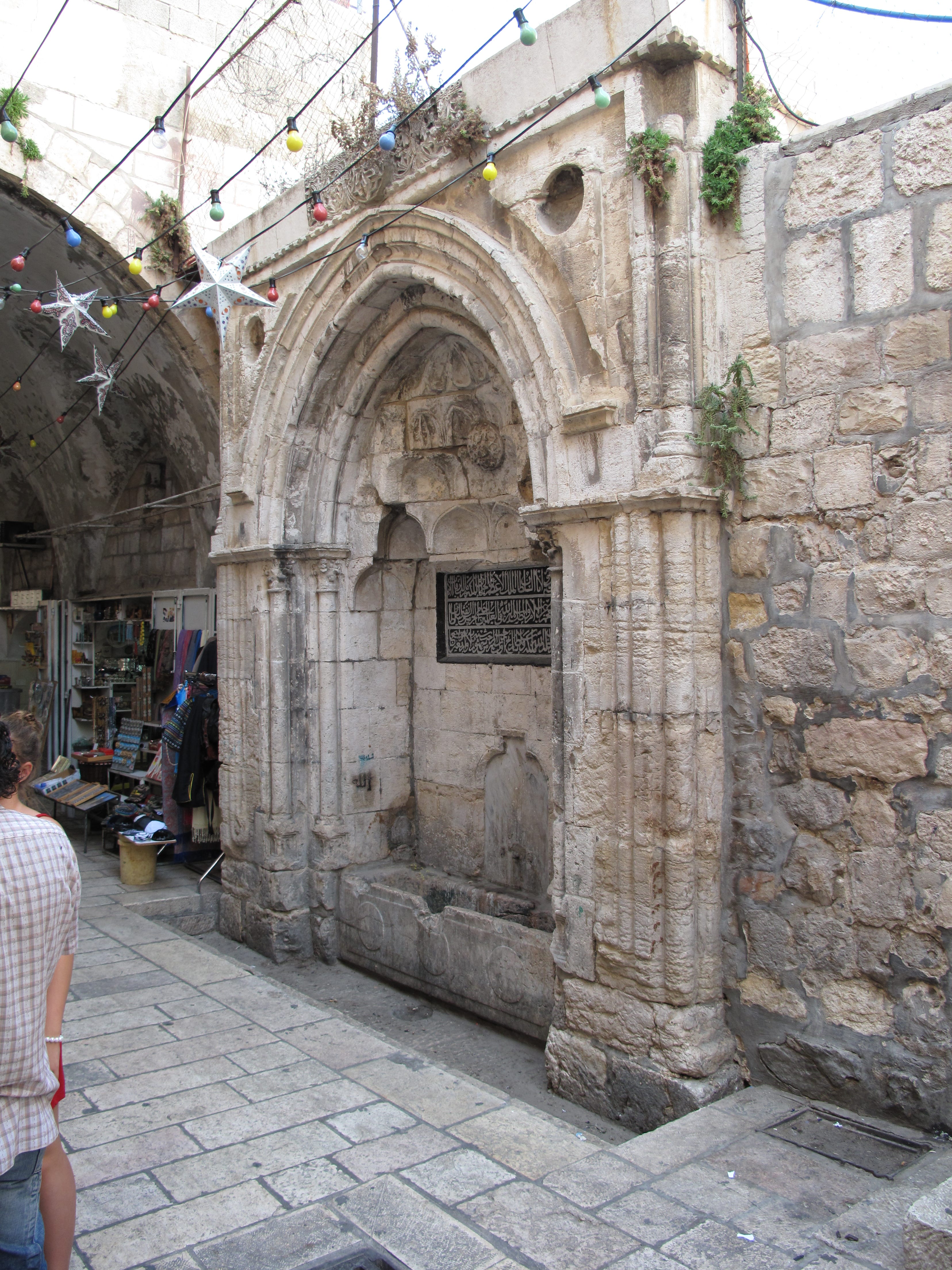
Sabil el Wad in Jerusalem. Photo by Juandev. (Creative Commons License)
The inscriptions, as you may have noticed above do not reference Gregorian years. Instead, they refer to Islamic years, or Hijri years, which are based on the Islamic lunar calendar. The counting for this system began in AD 622 when Muhammad migrated from Mecca to Medina. Because the system is lunar based, the starting time of the year is not tethered to the seasons, as our Gregorian calendar is. In other words, it rotates over time, since the year is only 354 days in length. In Hijri year 943, for example, the year would have begun in July.
Now, there are few possible sources of error when our mainstream history went about correlating Hijri years to Gregorian years. But I think the one most likely to have been responsible for this one-year delta is the starting year. They may have gotten the starting year wrong. What if in all actuality it was AD 623? Then everything would be off by one year.
This is what I believe most likely happened. After all, AD 623 was over 1,400 years ago. We do not necessarily have 100% precision on dates that old. Frankly, being one year off is well within reasonable expectations for the starting point of the Islamic calendar.
In short, I believe the correct starting point for the decree, based on the evidence we have, is December 14, 1537. Now, could the decree actually have been given two or three weeks before that day, and the oldest inscription was simply crafted a bit later, after the workers had had enough time to construct the fountain? That is entirely plausible and I would say even likely. But it doesn’t really change anything. If the decree was given November 26th (a random date), everything else would still fit perfectly. Either way, the abomination takes place early in the seventieth week, leaving seven full years for burning weapons (Ezekiel 39:8-9).
Based on accepting the December 14, 1537 date as the best one we have, then December 14, 2020 was exactly 483 years and 1 day after the decree. In other words, it was 1 day into the seventieth week.
Now, because the abomination took place almost immediately at the start of the seventieth week, there are seven years between the abomination and the start of the 490th year. The 490th year must begin in order for the prophecy to be fulfilled. But it also must not end prior to the return of Christ. Do you see? The 490th year must begin. But the 491st must not.
This simple logic, then, gives us a one-year time window for the return of Christ. He must return after 12/14/2027, yet before 12/14/2028.
3 - The Fig Tree Generation
Jesus Christ is not just a Priest, and he is not just a King. He is also a Prophet.
From the fig tree learn its lesson: as soon as its branch becomes tender and puts out its leaves, you know that summer is near. So also, when you see all these things, you know that he is near, at the very gates. Truly, I say to you, this generation will not pass away until all these things take place.
— Matthew 24:32-34
The parable of the fig tree is often contemplated for its eschatological meaning, yet seldom is it properly understood.
In Scripture, there are three trees used to symbolize Israel. The vine and the olive tree are often used as symbols of Israel’s spiritual and religious privileges. And the fig tree is often used as a symbol of Israel’s national privileges (Hosea 9:10 and Jeremiah 24).
National Israel is a sign intended for our use. And as many others have identified, the budding of the fig tree symbolizes the rebirth of Israel after a long winter. The Apocalypse of Peter contains a scene with Yeshua helping the disciples to make this very connection, proving that the link has been well known since the birth of Christianity. Yet many seem to have forgotten.
However, when Christ said that this generation would not pass, was he providing a timing detail to be used along with this regathering of Israel?
I believe the answer can be found in the only piece of Scripture attributed to Moses outside of the Torah.
The days of our years are threescore years and ten; and if by reason of strength they be fourscore years, yet is their strength labour and sorrow; for it is soon cut off, and we fly away.
— Psalm 90:10
It appears that 80 years is the outside length of time for a human lifespan; or, in other words, for a generation. As usual, God always gives mankind as much time as possible for repentance, within the structure of his plan. Therefore, I believe we should logically expect either the 79 or the 80 year mark from Israel’s rebirth to be quite significant.
Because of how the Ezekiel 4 prophecy was fulfilled in the 40th year itself, I believe we should expect the Fig Tree Generation to be fulfilled in the 80th year, but just shy of the 81st.
Given that historically the nation state of Israel was restored on May 14, 1948, the 80th year will begin in May of 2028. But logically, the 81st year (May 2029) must never arrive. Christ will arrive first.
2 - The Time of Jacob’s Trouble
Lastly, there is Jeremiah’s prophecy regarding the time of Jacob’s trouble.
Alas! for that day is great, so that none is like it: it is even the time of Jacob’s trouble; but he shall be saved out of it.
— Jeremiah 30:7
This passage has always bothered me because I know, based on the book of Genesis, that Jacob’s trouble was either 20 years (as stated by Jacob himself, Genesis 31:38 & 41) or 21 years (as stated by God through Moses, Genesis 29:20-30). Yet most modern Christians have decided that the time of Jacob’s trouble must necessarily be equivalent to Daniel’s seventieth week. This is troubling, no pun intended, as no one seems able to provide any scriptural basis whatsoever for making this assumption.
I would be far more comfortable with either a 20 or 21-year time of Jacob’s trouble.
Interestingly, the eclipse timeline, which creates the structure for what I call “God’s Final Week,” does allow for this. With a start point of 9/11/2007, the 21st year will begin on 9/11/2028. If we assume that 21 years is correct (God’s declaration), then this means the 21st year provides a third one-year window, running from 9/11/28 to 9/11/29.
1 - The Days of Noah
When Christ’s disciples asked him on the Mount of Olives, just a few days before his death, what the sign of his coming and of the end of the age would be, he gave them a detailed answer. But at the heart of that answer was a mysterious event called the abomination of desolation. That event, it is reasonable to conclude, is the ultimate sign of his coming and of the end of the age.
The abomination of desolation (final fulfillment of Matthew 24:15) already began in 2020, as covered in Section 4 above. The man of sin has already sat down in the temple of God (the human body). The surprising twist is that the abomination was also a profound and symbolically perfect return to the days of Noah. Again, Christ’s words are prophetic in ways which most have missed.
As it was in the days of Noah, so it will be at the coming of the Son of Man.
— Matthew 24:37 (NIV)
Now, there are many different features of the days of Noah which could potentially return at the end of the age. But I believe the most significant one was the widespread genetic corruption caused by the rebellious angels of Genesis 6. The creation of unsanctioned hybrids all over the face of the earth was an abomination in the sight of God, no doubt. And it ultimately led to the destruction of the earth by the flood.
This time around, the genetic corruption may be via a different means, but it is no less real. And it will ultimately lead to the destruction of this entire realm by fire at the last day.
How long will the unsanctioned hybrids roam these lands? Scripture provides us the typology, as always.
this is the interpretation, O king: It is a decree of the Most High, which has come upon my lord the king, that you shall be driven from among men, and your dwelling shall be with the beasts of the field. You shall be made to eat grass like an ox, and you shall be wet with the dew of heaven, and seven periods of time shall pass over you, till you know that the Most High rules the kingdom of men and gives it to whom he will.
— Daniel 4:24-25
How long was Nebuchadnezzar part man and part beast? Seven years. This aligns with another well-known end times prophecy.
Therefore, thou son of man, prophesy against Gog, and say, Thus saith the Lord GOD; Behold, I am against thee, O Gog, the chief prince of Meshech and Tubal: And I will turn thee back, and leave but the sixth part of thee, and will cause thee to come up from the north parts, and will bring thee upon the mountains of Israel: And I will smite thy bow out of thy left hand, and will cause thine arrows to fall out of thy right hand. Thou shalt fall upon the mountains of Israel, thou, and all thy bands, and the people that is with thee: I will give thee unto the ravenous birds of every sort, and to the beasts of the field to be devoured. Thou shalt fall upon the open field: for I have spoken it, saith the Lord GOD. And I will send a fire on Magog, and among them that dwell carelessly in the isles: and they shall know that I am the LORD. So will I make my holy name known in the midst of my people Israel; and I will not let them pollute my holy name any more: and the heathen shall know that I am the LORD, the Holy One in Israel. Behold, it is come, and it is done, saith the Lord GOD; this is the day whereof I have spoken. And they that dwell in the cities of Israel shall go forth, and shall set on fire and burn the weapons, both the shields and the bucklers, the bows and the arrows, and the handstaves, and the spears, and they shall burn them with fire seven years …
— Ezekiel 39:1-9
Notice particularly how before “the day whereof I have spoken” arrives (the day of the Lord) there are seven years of burning weapons. Based on the preceding verses, these final years appear to be characterized by the judgment of those who have placed their trust outside of God. The wicked doers will fall upon the open field, dying suddenly as part of God’s judgment on evil and his final warning for humanity.
Interestingly, even in the flood story, there is an appear of this same seven.
Noah was six hundred years old when the flood of waters came upon the earth. And Noah and his sons and his wife and his sons’ wives with him went into the ark to escape the waters of the flood. Of clean animals, and of animals that are not clean, and of birds, and of everything that creeps on the ground, two and two, male and female, went into the ark with Noah, as God had commanded Noah. And after seven days the waters of the flood came upon the earth.
— Genesis 7:6-10
I believe that these seven days mentioned here also point to the final seven years. Just as Noah and his family were protected in the ark for those final seven days prior to the flood judgment, so too God’s people are protected from the genetic corruption taking place just prior to the judgment of fire at Christ’s return.
With a starting point of December 2020, we know that the seventh year will run from December 2027 to December 2028. Logically, the eighth year must never arrive. So, this marker, too, points to Feast of Trumpets 2028.
Closing Thoughts
For me, it is not any one marker on its own which can provide total confidence in the year of Christ’s return. Instead, it is the shocking convergence of all eight of these scriptural markers on a single year which provides a high degree of certainty. But still, it does take faith to see the historical fulfillments of these things and trust that God will keep his promises.
The numeric biblical prophecies were provided to us for a reason. Was it not so that we might discern the general season of Christ’s return?