



The dispensational view of the end times is extremely popular. Today, somewhere north of 100 million Christians around the world adhere to this paradigm of thought. And the timeline, as shown in the simple graphic below, is invariably the same.
The Church is raptured prior to the final seven years of this age, which they call the Tribulation. Exactly halfway through the Tribulation, the man of sin sits in a rebuilt third Temple in Jerusalem and commits the abomination of desolation. This kicks off the Great Tribulation, which lasts for the remaining 3.5 years.
After this, Christ comes back for the Day of the Lord, which is equivalent to his Second Coming.
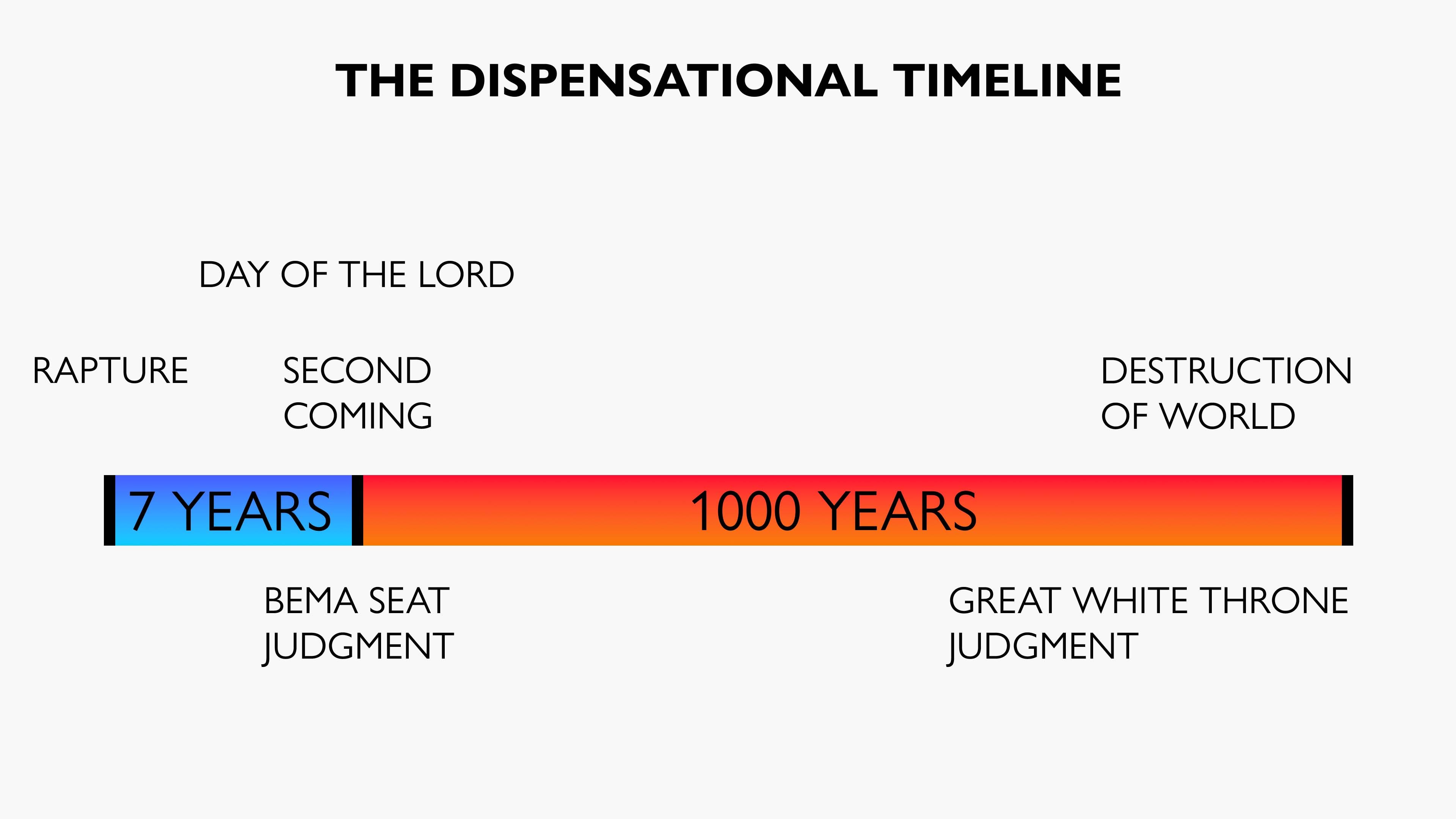
Notice how the 1,000 year future millennial reign necessitates the breaking up of the Final Judgment into a minimum of two distinct and separate judgments. The saints simply must be rewarded before they can reign with Christ over the earth. Sometimes, dispensationalists will theorize as many as four distinct judgments, but two is sort of the standard doctrine. The key point is that the Bema Seat judgment and the Great White Throne judgment are decidedly different events in this paradigm. They are separated by many years.
Notice also how this present fallen earth continues to exist during the entire millennial reign and is not destroyed until the end of that time period.
Given the view’s popularity, you would think we could easily find Scripture passages to support this overall timeline of events. It must be explicitly stated somewhere in the good book. Right? I mean 100 million people can’t all be wrong, can they?
You must understand, this general eschatological timeline is practically universally agreed to within the dispensational community, and it has grown to represent sort of the cornerstone of dispensational thought. In other words, if this timeline goes down, it all goes down.
And the surprising truth is that instead of supporting this timeline the Scriptures themselves - when we take the time to simply read them - consistently contradict it.
Now, right up front I want to be clear that eschatology is not a first order issue. For the most part, matters of eschatology tend to fall in either the second or third order buckets. For example, I would say the relative timing of the rapture is a second order issue, since we need to know what we should be watching for leading up to Christ’s return. However, the existence of one versus two final judgments I would argue is a third order issue of even less importance, since it has little bearing on how we live our lives day to day.
Please understand, I am not saying that making sense of all this end times stuff is the most important thing in the Christian life. It is not. In fact, my family and I attend a Baptist church where the majority of folks are dispensational in their eschatology. Why have I chosen to attend this Church? The answer is simple. We agree on the first order issues. You see, there is a stream within the Baptist movement which I agree with on nearly 100% of the first order issues. It just so happens, though, that most Baptists are off in their eschatology. Still, eschatology is of lesser importance, and I don’t believe in letting things which matter more be subject to things which matter less.
Now, this does put me in the position of sometimes being forced to call out errors in the commonly held eschatological stance of our congregation. I attempt to do this graciously and with love, though at times I may fall short of the mark.
With all that being said, I want to examine how Scripture disproves three key elements of the dispensational (dispy) timeline.
The Pre-Trib Rapture
The Future Millennial Reign
The Two Distinct Judgments
There are many other “attack vectors” provided by the Scriptures in terms of refuting dispensationalism writ large. We could talk about “all Israel” as a theological construct in Romans 11, or about many of God’s Old Testament promises being explicitly mentioned as fulfilled in the book of Joshua, or about Christ reigning now and binding the “strong man” (Satan) at the cross, or we could discuss at great length the many nuances associated with Second Temple Period Jewish apocalyptic literature which includes the book of Revelation. These discussions would be informative, but they all require getting well off the beaten path and into the weeds. You should know that my perspective takes for granted that all of these various rabbit holes have already been thoroughly explored (by me) and the answers have more or less been collected and satisfactorily tallied up. Those answers are never all that favorable for dispensationalism, but explaining all of them in tedious detail here is not my desire.
Instead, I want to limit this post to only the strongest and the most blazingly obvious of logical scriptural arguments against this popular timeline. In other words, we don’t even need all the minor arguments. The major ones are powerful enough to thoroughly expose the sloppy thinking upon which today’s pop eschatology has been precariously built.
1. The Pre-Trib Rapture
Now, first of all, the Scriptures do hint strongly that there is an end times rapture of believers to the Father’s house. See John 14:1-3 and Isaiah 26:20-21.
So, to be clear, I’m not questioning the existence of the rapture here. The question in my mind, though, is what is the relative timing of this event. Is is prior to the last seven years? Or is it after those seven years and at the very end of this fallen age?
As usual, I want to see what Scripture actually has to say. I’m not interested in blindly trusting the well-entrenched favorite doctrines of our particular generation. There’s simply too much at stake for that sort of sloppy approach.
Let’s start with a classic rapture passage.
For this we declare to you by a word from the Lord, that we who are alive, who are left until the coming of the Lord, will not precede those who have fallen asleep. For the Lord himself will descend from heaven with a cry of command, with the voice of an archangel, and with the sound of the trumpet of God. And the dead in Christ will rise first. Then we who are alive, who are left, will be caught up together with them in the clouds to meet the Lord in the air, and so we will always be with the Lord.
— I Thessalonians 4:15-17
This passage speaks directly to the rapture event where we are “caught up” to meet Christ in the air. Importantly, it links the rapture and resurrection. Those two are clearly a single event.
I Corinthians 15:51-52 also confirms that the resurrection and rapture are a single event, and it further links this event to “the last trumpet.”
Now, what does Christ have to say about the timing of the resurrection?
“For this is the will of my Father, that everyone who looks on the Son and believes in him should have eternal life, and I will raise him up on the last day.”
— John 6:40
Based on the dispensational timeline I’ve already shown, the “last day” could conceivably take place in one of two spots. It could either be at the return of Christ on the last day of this age, before the 1,000-year future reign of Christ (if such a thing exists). Or it could be the very last and final day of this fallen earth, which would occur after the 1,000 years have ended. (It could also be both, if both do in fact occur on the same day, as we will see.)
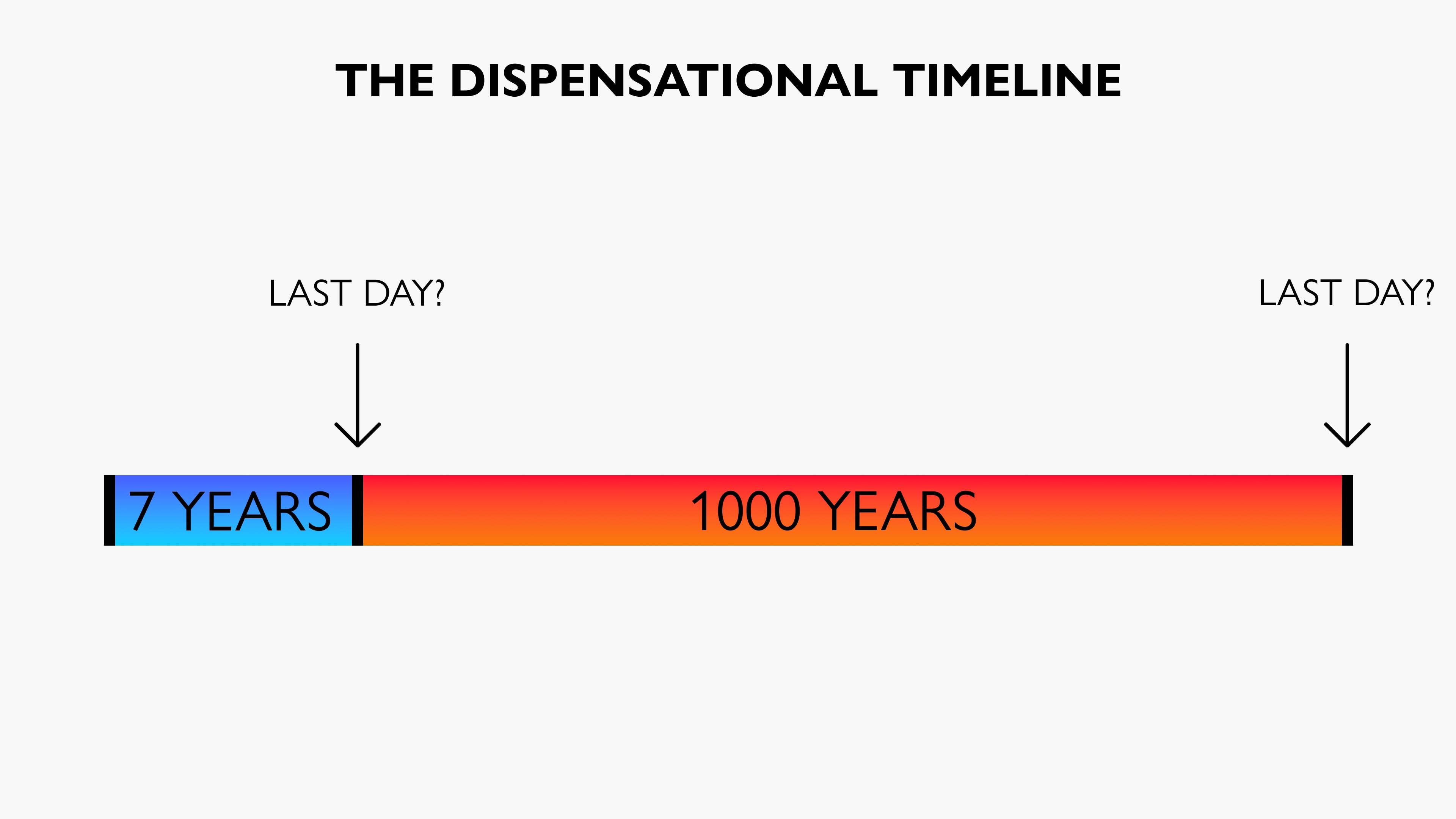
But either way, the “last day” can never conceivably be seven years before the Second Coming of Christ. Do you see? The idea that the rapture and resurrection occur seven years prior to the Second Coming of Christ can never be a literal interpretation of John 6:40, which means that dispensationalists quite simply do not take Christ’s words here literally. They cannot.
However, this is not even the strongest argument against pre-trib timing. I believe the strongest argument comes from two verses which both plainly state the relative timing of the rapture event. And, importantly, both of these passages agree quite closely with each other.
Likewise, just as it was in the days of Lot—they were eating and drinking, buying and selling, planting and building, but on the day when Lot went out from Sodom, fire and sulfur rained from heaven and destroyed them all—so will it be on the day when the Son of Man is revealed.
— Luke 17:28-30
Notice how Lot was delivered from Sodom “on the day” that fire and sulfur rained down from heaven and destroyed the wicked ones and their entire culture. Jesus said that it would be the same when the Son of Man is revealed. In other words, the end times believers will be delivered (raptured and resurrected) on the same day that Christ is revealed for his Second Coming. And what’s more this is also the same day that the evil doers will be destroyed as the fire comes down; they don’t get a seven-year reprieve any more than the people of Sodom did.
God almost always confirms key truths in his Word by providing at least two passages which both say the same thing. And the relative timing of the rapture is no different. He repeats himself for our benefit and in doing so he confirms the correct interpretation for us. We need only take notice and choose to believe what he tells us.
Here’s the confirmation.
This is evidence of the righteous judgment of God, that you may be considered worthy of the kingdom of God, for which you are also suffering—since indeed God considers it just to repay with affliction those who afflict you, and to grant relief to you who are afflicted as well as to us, when the Lord Jesus is revealed from heaven with his mighty angels in flaming fire, inflicting vengeance on those who do not know God and on those who do not obey the gospel of our Lord Jesus.
— II Thessalonians 1:5-8
When do we as believers get relief? What does the passage say? It says we get relief when the Lord Jesus is revealed from heaven in flaming fire. We clearly don’t get relief seven years before this dreadful event, as the dispensationalists would have it. We get relief on the same day Christ is revealed in flaming fire, that is the day we are rescued and delivered from this present evil age. Not before.
These two passages are both saying the same thing. Believers are delivered on the last day, when Christ is revealed in flaming fire, taking vengeance on the evil doers.
The pre-trib rapture, therefore, is not scriptural. It is little more than a fairly tale. It is a psyop for those who cannot be bothered to simply visit these two passages, to read them, and to believe what God has revealed.
2. The Future Millennial Reign
After what we’ve seen so far straight from the Scriptures, it’s clear that cracks are beginning to form in the dispy timeline. But this is only the beginning.
Now, there is a strong argument to be made from Scripture that Christ is reigning already right now (see Revelation 3:21 for a single verse which shows it, but there is much, much more to unpack here). There is also a strong argument to be made that Revelation 19 and 20 are a classic case of recapitulation, or describing the same event twice from different frames of reference. This was a typical motif utilized in Second Temple Period Jewish apocalyptic literature, of which the Apostle John’s Apocalypse is a prominent example. However, while they are persuasive, I do not intend to fully flesh these arguments out here. Instead, I will stick with even simpler reasoning.
In this section, I want to make two logical arguments against a future millennial reign. However, the content in Section 3 will provide yet another argument which not only disproves the notion of two distinct judgments, but it also (if we are thinking carefully) disproves the future millennium as well. So, in total, I will provide three strong yet simple arguments.
First, let’s continue our examination of the rapture timing we began above, and see if this can shed any additional light on the ordering of key end times events.
We’ve already seen that the resurrection and the rapture are a single event, and that this event occurs on the last day. Now, let’s see what other events are linked to this same day in Scripture.
Now concerning the coming of our Lord Jesus Christ and our being gathered together to him, we ask you, brothers, not to be quickly shaken in mind or alarmed, either by a spirit or a spoken word, or a letter seeming to be from us, to the effect that the day of the Lord has come.
— II Thessalonians 2:1-2
This additional passage now links our gathering together to Christ (the resurrection/rapture event) to the coming of Christ (read “Second Coming,” because that is the logical equivalent) and also to the “day of the Lord.”
So, here’s the logic so far:
Resurrection/Rapture = Last Day = Second Coming = Day of the Lord
Now, the “day of the Lord” is a recurring Old Testament theme with a significant contextual background. It’s often associated with a day of destruction and doom.
Blow a trumpet in Zion; sound an alarm on my holy mountain! Let all the inhabitants of the land tremble, for the day of the Lord is coming; it is near, a day of darkness and gloom, a day of clouds and thick darkness! Like blackness there is spread upon the mountains a great and powerful people; their like has never been before, nor will be again after them through the years of all generations. Fire devours before them, and behind them a flame burns. The land is like the garden of Eden before them, but behind them a desolate wilderness, and nothing escapes them.
— Joel 2:1-3
Joel links the Day of the Lord to darkness, gloom, and devouring fire.
Wail, for the day of the Lord is near; as destruction from the Almighty it will come! … Behold, the day of the Lord comes, cruel, with wrath and fierce anger, to make the land a desolation and to destroy its sinners from it.
— Isaiah 13:6 & 9
Isaiah further links the day of the Lord to destruction which leaves the land desolate and destroys the sinners from it.
The word of the Lord came to me: “Son of man, prophesy, and say, Thus says the Lord God: “Wail, ‘Alas for the day!’ For the day is near, the day of the Lord is near; it will be a day of clouds, a time of doom for the nations.
— Ezekiel 30:1-3
Ezekiel says it’s a time of doom for the nations.
The great day of the Lord is near, near and hastening fast; the sound of the day of the Lord is bitter; the mighty man cries aloud there. A day of wrath is that day, a day of distress and anguish, a day of ruin and devastation, a day of darkness and gloom, a day of clouds and thick darkness, a day of trumpet blast and battle cry against the fortified cities and against the lofty battlements. I will bring distress on mankind, so that they shall walk like the blind, because they have sinned against the Lord; their blood shall be poured out like dust, and their flesh like dung. Neither their silver nor their gold shall be able to deliver them on the day of the wrath of the Lord. In the fire of his jealousy, all the earth shall be consumed; for a full and sudden end he will make of all the inhabitants of the earth.
— Zephaniah 1:14-18
Zephaniah has much to say, and he links the day of the Lord to fire once again, and also to a sudden end of all the inhabitants of the earth.
Are you getting a picture of what this day looks like? I hope so, but we’re not quite done with our string of New Testament logic.
As a reminder, so far we’ve linked the resurrection and rapture to the last day, to the Second Coming of Christ, and to the day of the Lord.
But the day of the Lord will come like a thief, and then the heavens will pass away with a roar, and the heavenly bodies will be burned up and dissolved, and the earth and the works that are done on it will be exposed. Since all these things are thus to be dissolved, what sort of people ought you to be in lives of holiness and godliness, waiting for and hastening the coming of the day of God, because of which the heavens will be set on fire and dissolved, and the heavenly bodies will melt as they burn! But according to his promise we are waiting for new heavens and a new earth in which righteousness dwells.
— II Peter 3:10-13
As Augustine famously said, “In the Old Testament the New is concealed, in the New the Old is revealed.” This means we should absolutely expect to learn more about the day of the Lord in the New Testament than in the Old Testament. But what is contained in the New should also still align with what is found in the Old.
And here in Second Peter, we have the payoff.
Peter declares that the day of the Lord involves the destruction and dissolution of this entire physical realm, going an important step further than anything we find in the Old Testament. He links the day to fire, just as the OT prophets did, saying that the heavens will be “set on fire and dissolved.” And in case you aren’t quite sure, he even seals the deal by stating plainly in verse 13 that we are awaiting new heavens and a new earth. In other words, there’s going to be nothing of the old one left anymore once it’s dissolved. This is not some minor dissolving we are talking about here, some minor destruction. This is total destruction to the point that the old earth is done and gone. After all, he says the heavens will “pass away.” This is the end of this fallen world that Peter is describing here, and he links it firmly to “the day of the Lord.”
So, let’s update our string of logic on the last day one more time.
Resurrection/Rapture = Last Day = Second Coming = Day of the Lord = Destruction of Entire Physical World
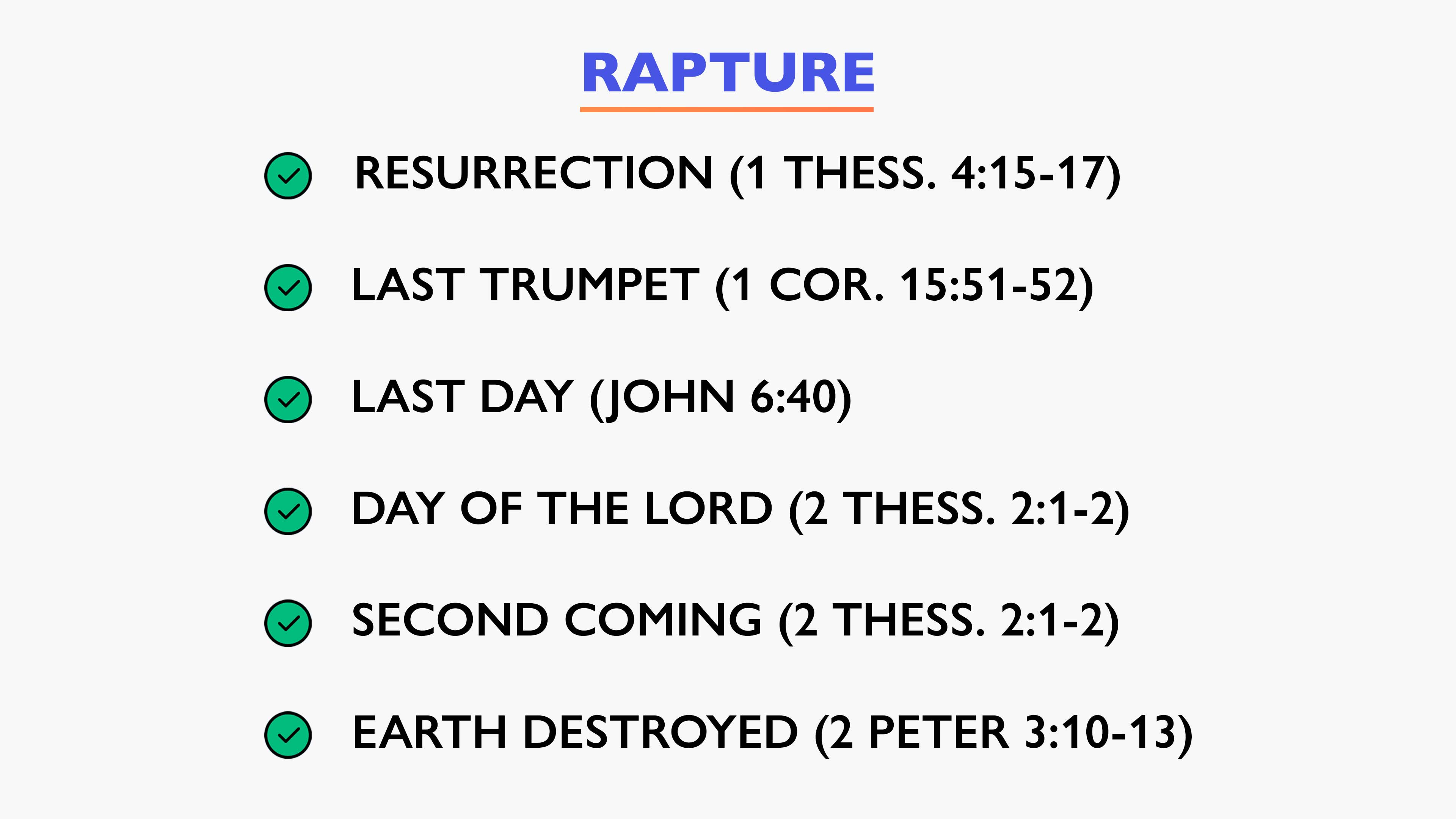
How does this fit with the dispy timeline?

As you can see for yourself, it doesn’t. The Bible collapses this whole fake timeline into a pile of rubble. Everything above the timeline pretty much collapses down, as you can see, into a single event. In short, the rapture happens at the Second Coming of Christ, which is also know as the day of the Lord and which involves the utter and complete destruction of this fallen world.
Notice that there has been no rocket science here. There has only been the simple examination of Scripture, the simple use of God-given logic, and the simple act of humbling ourselves before the text itself. You don’t need to be a Greek scholar to figure this out. Frankly, you don’t even need to have a high IQ. You only need to believe God’s word. But perhaps that is the hard part.
Do you see how this much beloved timeline is exposed as complete rubbish by the Scriptures themselves? Compared to the beautiful simplicity revealed in Scripture, man’s doctrines seem painfully convoluted and contrived. And yet, they hold feeble minds fast.
Let’s look at one more straightforward argument against the future millennium before moving on to the topic of the two distinct judgments.
In First Corinthians 15, Paul has quite a bit to say about the resurrection and the rapture and about what it all means. I encourage a careful reading of verses 12 through 58 to sharpen your understanding of Paul’s end times perspective.
Here is one of the sections I want to focus on.
But each in his own order: Christ the firstfruits, then at his coming those who belong to Christ. Then comes the end, when he delivers the kingdom to God the Father after destroying every rule and every authority and power. For he must reign until he has put all his enemies under his feet. The last enemy to be destroyed is death.
— I Corinthians 15:23-25
(Side note from verse 24: Christ is reigning now. This means that the millennium of Revelation 20:1-10 is taking place right now! Christ is reigning from his throne in heaven and the dead saints are reigning with him. The millennium is taking place in heaven right now, it is not some future earthly state. Revelation 20 is simply a recasting of Revelation 19, written from a heavenly perspective.)
Specifically, I want you to notice how Paul says in verse 25 that, “the last enemy to be destroyed [after the resurrection, as indicated by the broader context of verses 20-25] is death.” This is interesting. The last enemy is destroyed at the resurrection, when Christ comes, and when he delivers up (why not “establishes” if pre-millennialism is true) the kingdom to the Father.
Now, just in case you think that this defeat of death happens at some time other than at the resurrection of the just, Paul has more to say on the matter.
I tell you this, brothers: flesh and blood cannot inherit the kingdom of God, nor does the perishable inherit the imperishable. Behold! I tell you a mystery. We shall not all sleep, but we shall all be changed, in a moment, in the twinkling of an eye, at the last trumpet. For the trumpet will sound, and the dead will be raised imperishable, and we shall be changed. For this perishable body must put on the imperishable, and this mortal body must put on immortality. When the perishable puts on the imperishable, and the mortal puts on immortality, then shall come to pass the saying that is written:
“Death is swallowed up in victory.”
“O death, where is your victory?
O death, where is your sting?”
— I Corinthians 15:50-55
Do you see how Paul is tying this back to what he said earlier in verse 25? When is death defeated? At the last trumpet, when we are changed in the twinkling of an eye.
Now, all pre-millennialists agree that there will be death of animals and non-believers during the millennial reign. But if that is the case, what kind of hollow victory is this which Paul speaks of? Death is defeated at the rapture for the saints, yet they will continue to live in a fallen world full of death for 1,000 more years? Nonsense.
You cannot take I Corinthians 15 literally and hold to a future millennial reign. It just does not work, logically speaking. I realize that pre-millennialists can potentially try to argue that death is simply no longer a factor for the saints themselves, although it remains a reality for others. However, this argument doesn’t stand up to scrutiny either. Notice that Paul says death is the “last” enemy to be defeated. Do we really expect the “last enemy” to be defeated at the “last trumpet” on the “last day” but yet this all occurs 1,007 years before the end of this fallen world? Hate to break it to you, but last means last.
Here’s what God says about the eternal state in the new heavens and new earth.
Then I saw a new heaven and a new earth, for the first heaven and the first earth had passed away, and the sea was no more. And I saw the holy city, new Jerusalem, coming down out of heaven from God, prepared as a bride adorned for her husband. And I heard a loud voice from the throne saying, “Behold, the dwelling place of God is with man. He will dwell with them, and they will be his people, and God himself will be with them as their God. He will wipe away every tear from their eyes, and death shall be no more, neither shall there be mourning, nor crying, nor pain anymore, for the former things have passed away.”
— Revelation 21:1-4
Instead of claiming that death is “defeated” 1,007 years before this other time when “death shall be no more,” doesn’t it make far more sense to have them both occurring at the same general time? After all, the simpler explanation of the two (Occam’s razor) is more likely to be correct.
3. The Two Distinct Judgments
Now for the fun part. Let’s examine one last simple argument that absolutely levels whatever is left of the dispy timeline.
I love this one because realistically the opposing side has no remotely coherent way of countering it.
Over the years, an elaborate doctrine of the Bema Seat judgment (as referenced by Paul in Romans 14:10-12 and 2 Corinthians 5:10) as separate and distinct from the Great White Throne judgment (referred to in Revelation 20:11-15) has taken hold within dispensational circles. They make the claim that the Bema Seat is for the rewarding of believers only. Likewise, they claim that no believers will be present at the Great White Throne judgment, as this judgment is for unbelievers only.
Often, it seems that dispensationalists do not even bother acknowledging opposing views on the final judgment. Instead, they typically present their own claims as though they are self-evident from the text and should be obvious to everyone who reads the Bible. However, nothing could be further from the truth.
The times of ignorance God overlooked, but now he commands all people everywhere to repent, because he has fixed a day on which he will judge the world in righteousness by a man whom he has appointed; and of this he has given assurance to all by raising him from the dead.”
— Acts 17:30-31
In the Greek, the word “day” here is singular. There is a single day on which God will judge “the world.” Not unbelievers only. Not the righteous only. The whole world.
on that day when, according to my gospel, God judges the secrets of men by Christ Jesus.
— Romans 2:16
Once again, day is singular in the Greek. And notice how God has again repeated himself for our benefit. He doesn’t want us to miss this important detail.
Based on just these first two verses, we already have no reason to break up the Bema Seat and the Great White Throne into two distinct judgments. Why couldn’t they simply be two different ways of describing the same event?
But there is more.
The key thing that the dispensationalists are trying to do by breaking the final judgment up is to provide a way for the saints to be rewarded prior to the future millennial reign (which we’ve already demonstrated above is not scripturally supported). In other words, the saints must be rewarded separately from the judgment of the sinners, and from the destruction of the Devil and his angels, for the timeline to stand.
The nations raged, but your wrath came, and the time for the dead to be judged, and for rewarding your servants, the prophets and saints, and those who fear your name, both small and great, and for destroying the destroyers of the earth.”
— Revelation 11:18
The Greek word translated “the time” is again singular. The time. The one time. The only time. The saints are rewarded at the same time as the wicked are judged and the Devil and his angels are destroyed. Do you see it? It’s all right here in this plain verse. The more important question may be: will you choose to believe what God has said? Or will you instead look for a fancy way to make this verse say the exact opposite of what it actually says? The irony of doing that to this particular verse, is that you will be stealing from your own future eternal reward if you choose to twist its plain meaning. Your choice.
What I find interesting, is that even Revelation chapter 20 itself refutes the idea of two judgments.
Then I saw a great white throne and him who was seated on it. From his presence earth and sky fled away, and no place was found for them. And I saw the dead, great and small, standing before the throne, and books were opened. Then another book was opened, which is the book of life. And the dead were judged by what was written in the books, according to what they had done. And the sea gave up the dead who were in it, Death and Hades gave up the dead who were in them, and they were judged, each one of them, according to what they had done. Then Death and Hades were thrown into the lake of fire. This is the second death, the lake of fire. And if anyone’s name was not found written in the book of life, he was thrown into the lake of fire.
— Revelation 20:11-15
The KJV translation of verse 15 is a bit unfortunate, but the ESV reading shown above is a better translation of the original Greek. “And if anyone’s name” is a good reading because the Greek literally says “And if anyone.” Three separate words. But crucially the word “if” is present. This indicates that it is not a foregone conclusion that all those present at the Great White Throne are not in the book of life. Why would God include the word “if” here if that was the case? Logically, based on the inclusion of this word, some people at this judgment are in the book and some are not. Remember, our God is a God of logic. We didn’t invent logic, he did.
The dispensationalist would have you believe that the book of life is brought out at the Great White Throne judgment only as a token ceremony. They would have you believe that the “if” in the Greek is entirely meaningless, since 100% of people at this judgment are thrown into the lake of fire. But does this view pass the test of strict logic?
You must understand, the dispensational timeline does not simply twist the one or two dozen verses we’ve examined so far on the rapture, the millennium, and the final judgment. It also is forced to twist the plain meaning of dozens of other passages throughout the Bible, some of which we all know and love. Think of the parables of Christ, for example.
Then he left the crowds and went into the house. And his disciples came to him, saying, “Explain to us the parable of the weeds of the field.” He answered, “The one who sows the good seed is the Son of Man. The field is the world, and the good seed is the sons of the kingdom. The weeds are the sons of the evil one, and the enemy who sowed them is the devil. The harvest is the end of the age, and the reapers are angels. Just as the weeds are gathered and burned with fire, so will it be at the end of the age. The Son of Man will send his angels, and they will gather out of his kingdom all causes of sin and all law-breakers, and throw them into the fiery furnace. In that place there will be weeping and gnashing of teeth. Then the righteous will shine like the sun in the kingdom of their Father. He who has ears, let him hear.
— Matthew 13:36-43
In saying that the good seed and the weeds are gathered at the same time (the Greek word translated “the harvest” is, perhaps unsurprisingly by now, singular) this passage hardly comports with the dispy timeline. Christ could have at least given us a clue here if there were to be multiple future harvests. But instead he dispenses with any such silly notion. Likewise, he could have indicated that the good seed is harvested many long years before the weeds are eventually thrown into the fire. Yet he does no such thing.
“Again, the kingdom of heaven is like a net that was thrown into the sea and gathered fish of every kind. When it was full, men drew it ashore and sat down and sorted the good into containers but threw away the bad. So it will be at the end of the age. The angels will come out and separate the evil from the righteous and throw them into the fiery furnace. In that place there will be weeping and gnashing of teeth.
— Matthew 13:47-50
This is just more of the same. An added confirmation on top of everything else. Why this talk of separating the evil from the righteous at the end of the age if the reality is to be so confusingly different?
As the coup de grace, we have Matthew 25.
“When the Son of Man comes in his glory, and all the angels with him, then he will sit on his glorious throne. Before him will be gathered all the nations, and he will separate people one from another as a shepherd separates the sheep from the goats. And he will place the sheep on his right, but the goats on the left. Then the King will say to those on his right, ‘Come, you who are blessed by my Father, inherit the kingdom prepared for you from the foundation of the world. … “Then he will say to those on his left, ‘Depart from me, you cursed, into the eternal fire prepared for the devil and his angels. … And these will go away into eternal punishment, but the righteous into eternal life.”
— Matthew 25:31-34, 41, & 46
The dispensationalist would have us believe that Christ’s words here are little more than a fanciful fairy tale. Their timeline does not allow for the final judgment event Christ speaks of to ever actually take place. The sheep and the goats never appear before the throne together. Instead, they appear 1,000 years apart.
This is not a respectful view of Scripture. It is not a literal view. It is a view which does repeated violence to the text. And it is, quite frankly, a view which will bear its own shame at the last day.
Closing Thoughts
With the dispy timeline clearly off the table as a viable paradigm of thought, where does this leave us? Are we to throw up our hands and say: “Well, we know it can’t be this (dispy timeline), but how it all actually plays out, we have no earthly idea.”
No, I don’t believe we must do anything of the sort. Now, the Word does not tell us every detail of the end times story, but it does provide enough of a framework for us to glimpse the big picture.
Now, when looking at biblical prophecy, and the book of Revelation in particular, if we are to get away from dispensational futurism we don’t necessarily need to jump straight to the other extreme, which is the preterist position. Christ did not come back in AD 70. That idea is intellectually bankrupt. We should instead, I believe, walk the narrow road of historicism, which recognizes that John’s Apocalypse has been being fulfilled down through history. Yes, the final bit is still yet to be fulfilled at and immediately following Christ’s return, but that doesn’t mean that the whole book is still waiting to be fulfilled during the final seven years, as the dispensationalists would have it.
So, here is how I believe we should replace the dispensational time, based on Scripture.
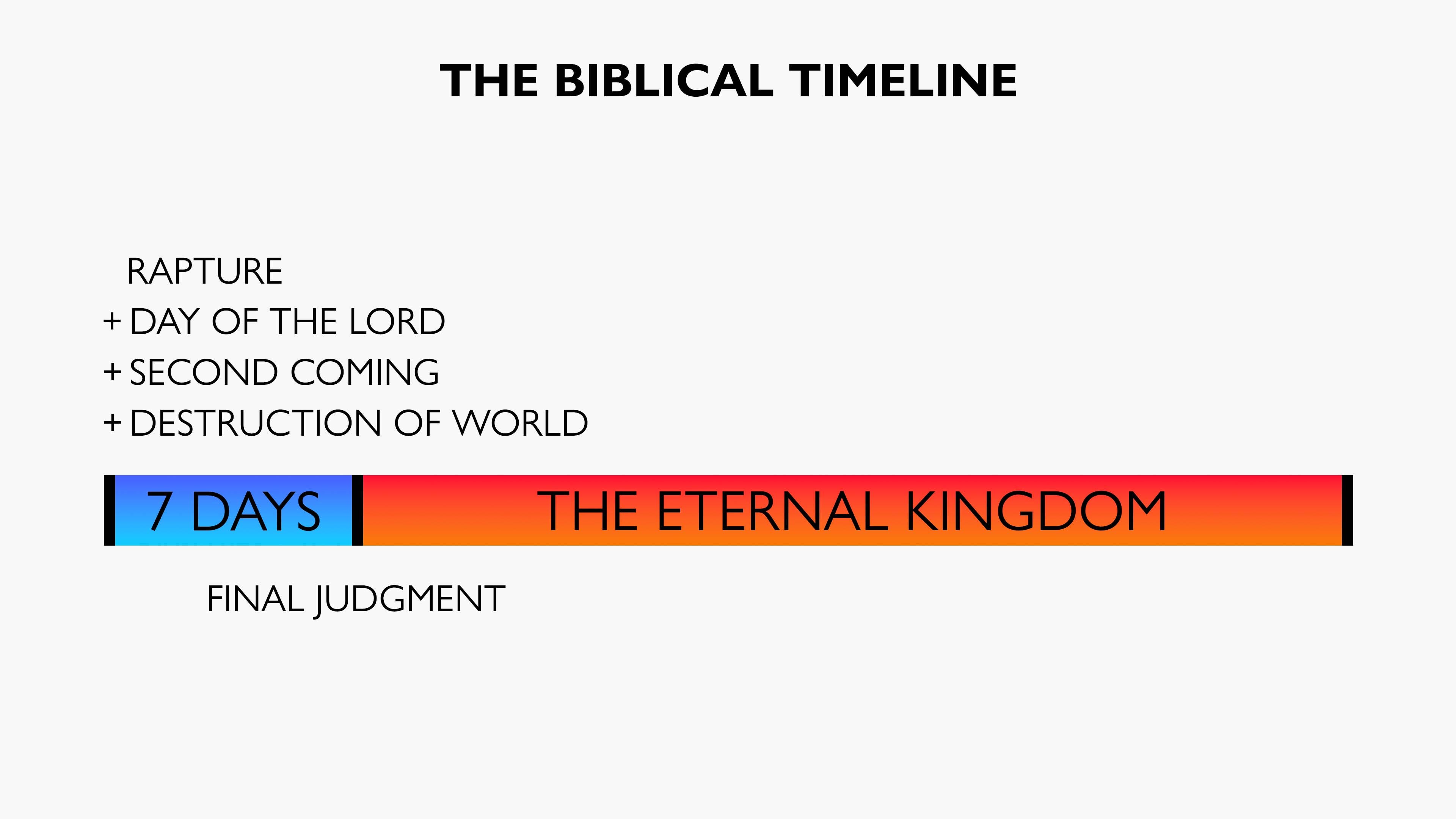
You’ve likely never heard of a view quite like this. So, let’s unpack my paradigm.
The sort of typical Amillennial view of the Second Coming is that everything happens on the same day, including the final judgment. This seems to make good sense of some passages, like for example Matthew 13 and 25 which we just saw. However, it creates issues with other passages and raises many additional questions.
Importantly, this view reduces the rapture into little more than a jump into the clouds to meet Christ in the air before we boomerang right back down to earth for the final judgment. And what happened to the total destruction of the physical world which Peter speaks of? If the heavens are being destroyed, are we still up there in the air somewhere with Christ just hanging out? Does the old world get destroyed and the new one get created that quickly?
I believe that the rapture is more than a giant boomerang event.
Let not your hearts be troubled. Believe in God; believe also in me. In my Father’s house are many rooms. If it were not so, would I have told you that I go to prepare a place for you? And if I go and prepare a place for you, I will come again and will take you to myself, that where I am you may be also.
— John 14:1-3
Christ seems to indicate that we will be going to the Father’s house (presumably, Heaven) at some point after he returns for us.
Come, my people, enter your chambers, and shut your doors behind you; hide yourselves for a little while until the fury has passed by. For behold, the Lord is coming out from his place to punish the inhabitants of the earth for their iniquity, and the earth will disclose the blood shed on it, and will no more cover its slain.
— Isaiah 26:20-21
If you read the context of Isaiah 25 and 26, you will see that this entering into the chambers occurs after the resurrection. And we know that the resurrection and rapture are a single event. So, here we find the reason for the rapture event. It is to protect us from the wrath poured out on the Day of the Lord. The wrath which destroys the sinners from the land and which ultimately destroys the entire physical world.
(Notice how a rapture 7 years before the Second Coming of Christ completely nullifies this the true purpose for the rapture, replacing it with man-made ideas of what God’s wrath looks like.)
Now, I have thoroughly dealt with God’s master timeline and how the ancient Jewish feasts foreshadow key redemptive events within this timeline in my book, God’s Final Week. It is not my intent to entirely rehash that here, but I will give a quick flavor of what that story looks like.
There are seven yearly feasts in the ceremonial calendar God instituted for the children of Israel, following the Exodus.
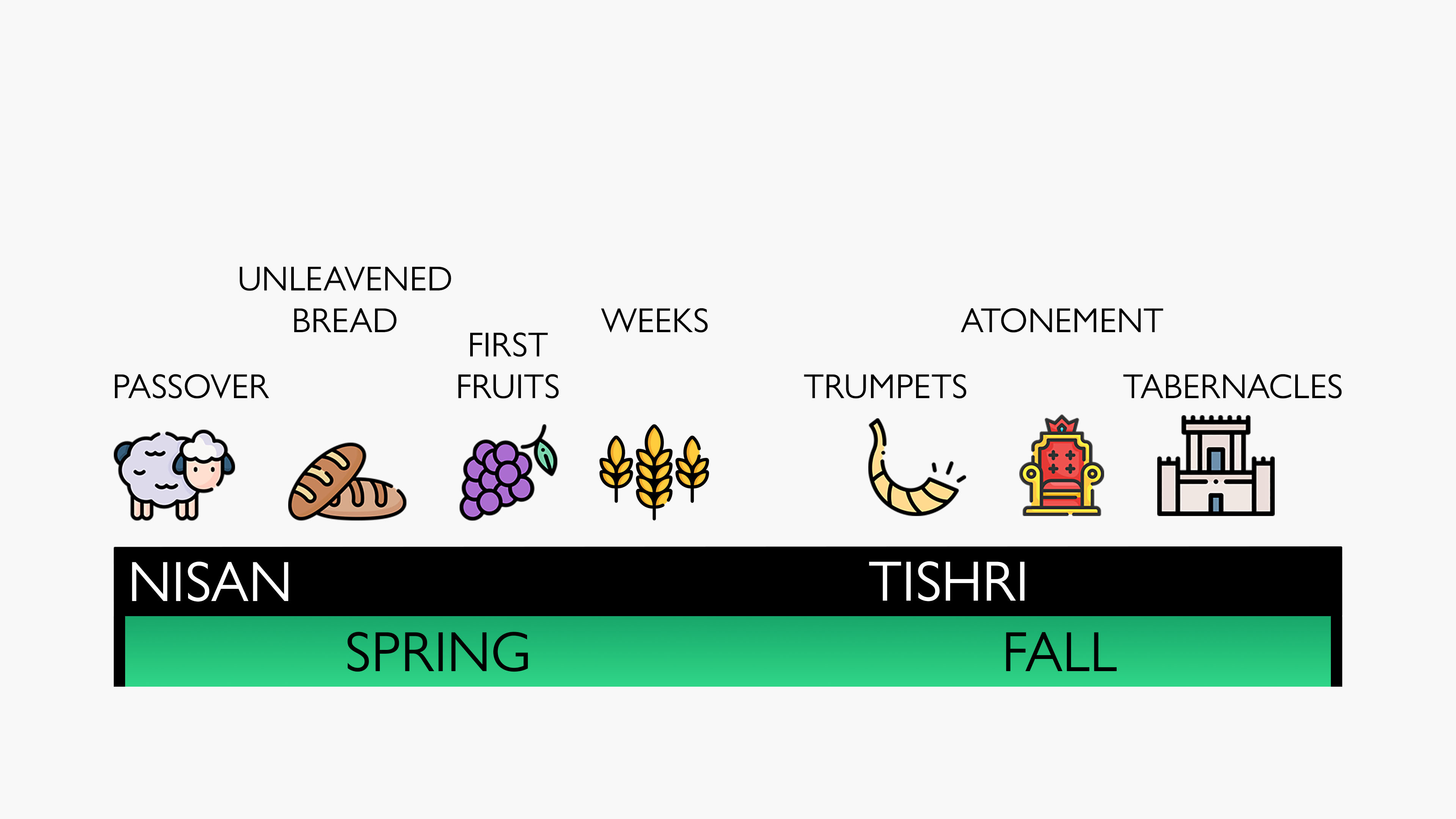
The four spring feasts were fulfilled in order at Christ’s first coming, during the year of the cross (year 4000). It is a safe assumption (and the typology aligns perfectly) that the three remaining fall feasts will likewise be fulfilled in order at Christ’s Second Coming (year 6000).
but that in the days of the trumpet call to be sounded by the seventh angel, the mystery of God would be fulfilled, just as he announced to his servants the prophets.
— Revelation 10:7
The next feast in line to be fulfilled is the two-day Feast of Trumpets, which occurs at the start of the fall harvest and perfectly types the return of Christ.
However, I believe the Scriptures give us a tantalizing end times clue when they reveal that the Jubilee year did not begin on Tishri 1. Instead, it began ten days later, on Tishri 10. What could the possible reason for this gap be? Could it have been pointing to an end times mystery all along?
You see the ancient Galileans had a wedding ceremony which involved seven days of feasting. And Christ famously used wedding typology at the Last Supper. Is it possible that the pre-tribbers are half right in claiming that this typology points also to the rapture of the Church? Could there yet be a gone for seven? But perhaps instead of the ill-conceived seven years, there is something more like seven days in the wedding chambers? Believe it or not, the month of Tishri seems to allow for such a time frame.
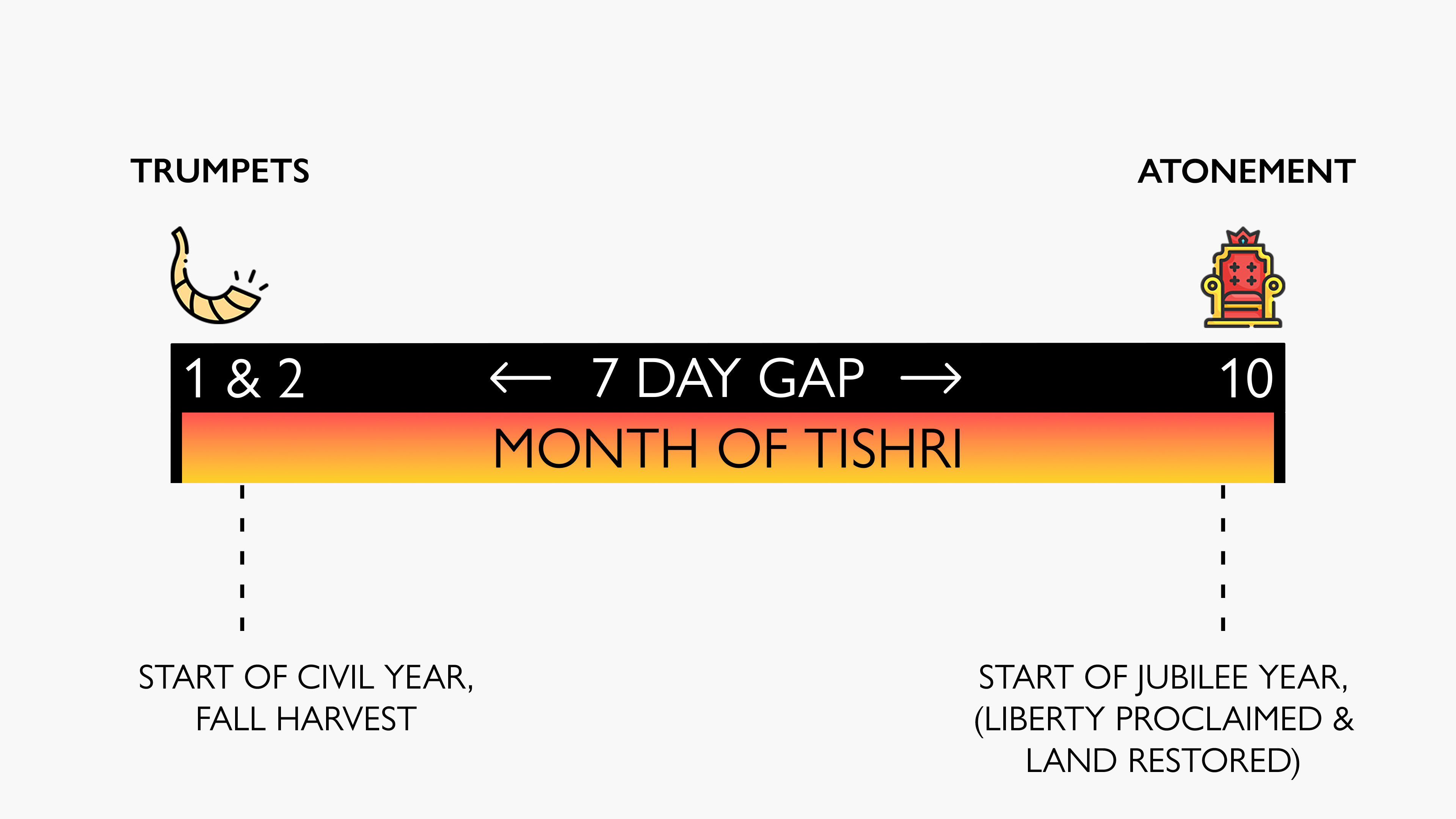
Interestingly, there is a gap of exactly seven days between the Feast of Trumpets and the Day of Atonement. The Day of Atonement is the next feast in line to be fulfilled and it falls on Tishri 10. Remember that this is the same day on which the Jubilee Year (with the themes of liberty proclaimed and land restored) begins. And the fact that the Day of Atonement types the final judgment is unequivocal.
Is God using the timing sequence of the fall feasts within the month of Tishri to tell us something? I believe he is.
In the end, the idea of everything being fulfilled in the year 6000, during the month of Tishri, is far simpler than concocting something as convoluted as the dispy timeline. It also has far more scriptural support. But however things play out in the days between Christ’s return and the final judgment, this much is clear from Scripture: 1) the rapture and resurrection take place post-trib and pre-wrath, 2) there is no future millennium, and 3) there is a single final judgment which awaits all of humanity.
If Scripture is so painfully clear on these topics, why is it that the masses of Christianity have become so confused on eschatology? Well, it’s interesting to note that dispensationalism has only come into prominence within the Church within the last 200 years or so (arguments to the contrary are incredibly lacking in scholarly rigor). And this timing is highly suspect when we realize that Satan surely knows the ending point of 2028, just as we do. What this means is that Satan has likely utilized dispensationalism as a means of distracting much of Christendom from some important end times truths. Not that all of the doctrine’s views are wrong, but rather that it has errors baked in at some critical points.
So, what is the goal of this deception? I believe that answer is quite simple. It is to distract Christians from the abomination of desolation. When Christ’s disciples asked him on the Mount of Olives, just a few days before his death, what the sign of his coming and of the end of the age would be, he gave them a detailed answer. But at the heart of that answer was a mysterious event called the abomination of desolation. That event, it is reasonable to conclude, is the ultimate sign of his coming and of the end of the age. And I have found this to be all too true as a believer in this final generation who has witnessed the incredible final end times fulfillment of Matthew 24:15 (let the reader understand). The abomination makes the end obvious. And yet, in dispensationalism, this event takes place 3.5 years after believers are raptured. So, people have been conditioned to never watch for this key sign. They ignore it and instead chase their own tails by making endless conjectures on red heifers, and third temple locations, and implantable chips and all the rest. This serves the Devil’s purpose, as it distracts from the deeper truths playing out in these last days, right in front of the unseeing eyes of the indoctrinated plebeian masses.
If you have been fooled by this clever and elaborate ploy, I do not blame you. But it is high time to awaken.